
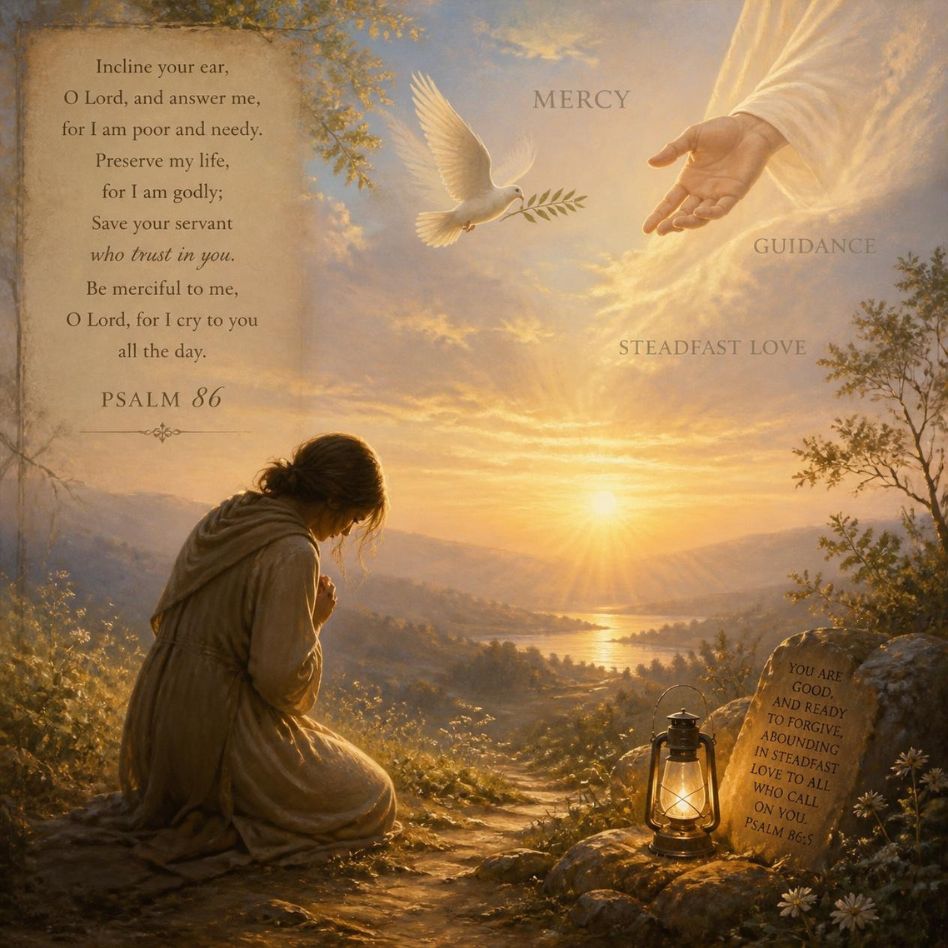
Read: Psalm 86:1-7 & Matthew 5:44 (NLT)
Watch: The Bible Project: Holiness
Prayer is a conversation.
When we talk to another person, there is a natural exchange. We share information, ideas, feelings, thoughts, and perspectives. A lot goes into a simple conversation! One person shares a thought, and the other responds with agreement, a question, or a friendly challenge. And so the conversation flows.
When we have a conversation with God, the dynamics are beautifully different. We are talking with the Almighty Creator of the universe. This naturally instills a deep respect—what the Bible calls a healthy “fear” of the Lord. We cannot see His face with our physical eyes, nor do we hear an audible voice.
But this is where Jesus’ teaching—and indeed, the entire biblical narrative—points us toward something deeper. We can see God, not with physical sight, but with the eyes of faith. We can hear His voice, not in an acoustic wave, but through His Word and His people. Like any relationship, we must practice and learn how to communicate with Him.
David spent years practicing this conversational prayer. He had plenty of quiet hours out in the wild watching his father’s sheep. In those mountain pastures, he learned to see God in everything and tune his heart to hear His voice. It was this deep, conversational connection that kept him anchored through all his years of struggle and running for his life.
The prayer-conversation recorded in Psalm 86 is incredibly instructive. In most psalms, David simply cries out to God in distress. But here, David does something unique: for every single request he makes, he gives God a reason. He anchors his pleas in who God is and who he is to God.
Here is how David structures his conversation:
| David’s Request | David’s Reason (Why He Asks) | The Heart Behind It |
| “Bend down, hear… answer me” | “I need your help.” | Dependence |
| “Protect me / Save me” | “I am devoted to you… I serve you… I trust you.” | Loyalty, Commitment, & Confidence |
| “Be merciful to me” | “I am calling on you constantly.” | Relationship |
| “Give me happiness” | “I give myself to you.” | Dedication |
| “Listen closely / Hear my cry” | “You are so good, so ready to forgive, so full of unfailing love.” | Praise, Atonement, & Grace |
| “I will call on you” | “You will answer me.” | Trust & Confidence |
This structure is beautiful because David isn’t telling God anything the Almighty doesn’t already know. Instead, by speaking these reasons aloud, David is reminding himself of the goodness, character, and track record of God. For every plea, he couples his cry with a reason for hope.
We can—and should—learn to pray just like David.
Pray: Take a few moments today to verbally express the words of Psalm 86 back to God. Make his requests, and his reasons, your own.
Discussion Questions:
1. The “Pasture” of Our Lives
David’s deep prayer life was built in the quiet, mundane, and often lonely spaces of his everyday job. In our hyper-connected, fast-paced world, quiet spaces don’t just happen—we have to fight for them.
- Reflection: What does your “pasture” look like right now? What is one daily routine or quiet moment you can intentionally protect this week to practice “seeing God in everything”?
2. Moving Beyond the “What” to the “Why”
It is easy for our prayers to become a spiritual grocery list—focusing entirely on what we want God to do. David, however, consistently pairs his requests with a declaration of who God is or where his own heart stands (e.g., “Save me, because I trust you”).
- Reflection: Think about your most frequent prayer request right now. If you were to pray like David, what “reason” would you attach to it? How does anchoring your request in God’s character (His goodness, mercy, or track record) change how you feel about the outcome?
3. The Eyes of Faith in Dry Seasons
David’s conversational relationship with God kept him anchored through years of running for his life in the wilderness. When our physical circumstances look bleak, the “eyes of faith” are tested.
- Reflection: Is there an area of your life right now where your physical eyes see confusion or struggle, but your “eyes of faith” are being called to trust? How can sharing this struggle honestly with God—treating prayer as a true, two-way conversation—help you hold onto hope?
July’s Psalm for Memorization:
Psalm 103
A psalm of David.
1 Let all that I am praise the Lord;
with my whole heart, I will praise his holy name.
2 Let all that I am praise the Lord;
may I never forget the good things he does for me.
3 He forgives all my sins
and heals all my diseases.
4 He redeems me from death
and crowns me with love and tender mercies.
5 He fills my life with good things.
My youth is renewed like the eagle’s!
6 The Lord gives righteousness
and justice to all who are treated unfairly.
7 He revealed his character to Moses
and his deeds to the people of Israel.
8 The Lord is compassionate and merciful,
slow to get angry and filled with unfailing love.
9 He will not constantly accuse us,
nor remain angry forever.
10 He does not punish us for all our sins;
he does not deal harshly with us, as we deserve.
11 For his unfailing love toward those who fear him
is as great as the height of the heavens above the earth.
12 He has removed our sins as far from us
as the east is from the west.
13 The Lord is like a father to his children,
tender and compassionate to those who fear him.
14 For he knows how weak we are;
he remembers we are only dust.
New Living Translation (NLT)
Holy Bible, New Living Translation, copyright © 1996, 2004, 2015 by Tyndale House Foundation. Used by permission of Tyndale House Publishers, Inc., Carol Stream, Illinois 60188. All rights reserved.